
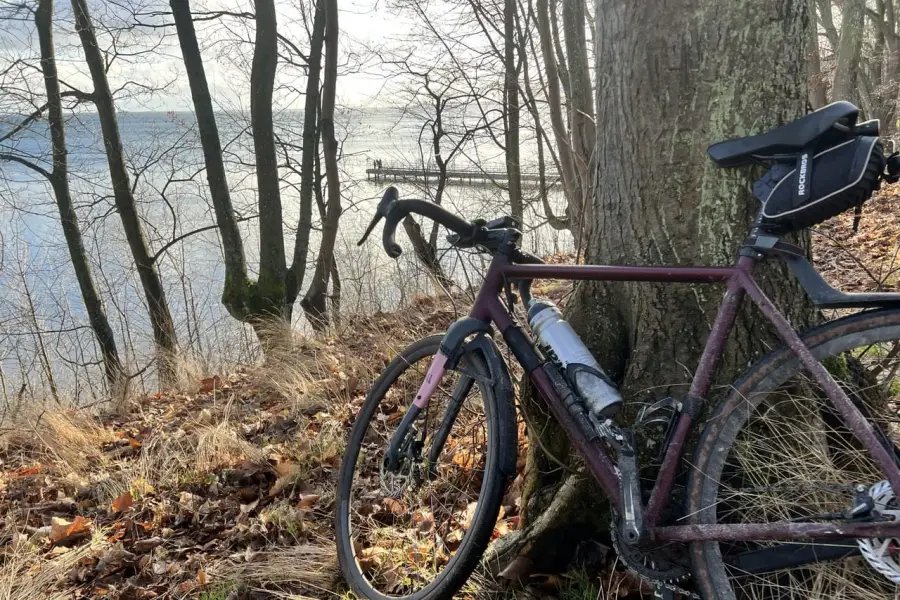
Gravel One Fifty
Key facts
- Date:
- 25 Apr 2026
- Edition:
- 2026
- Type:
- One-day (XC / race)
- Roden · Drenthe · Netherlands
- Distances:
- 80/150 km
- Series:
- UCI Gravel World Series
About
In the Netherlands, where flat terrain defines the cycling landscape, the Gravel One Fifty rewrites expectations with a course that demands far more than the horizon suggests. Starting from the historic Brink square in Roden, in the Drenthe region, the route unfolds across 80 or 150 kilometres of forest tracks, dirt paths and hidden trails through north-eastern Holland. Now in its fifth edition, the event attracted around 1,500 riders from more than fifteen countries, cementing its status as a major UCI Gravel World Series qualifier in northern Europe. The technical nature of Drenthe's woodland terrain surprises those who expect only flatness. Push Training 360 builds the race-specific block around sustained mean power on flat terrain and handling on loose surfaces: the coach fine-tunes weekly threshold sessions and pacing strategy so no kilometre without elevation is wasted.
Frequently asked questions
When does Gravel One Fifty 2026 take place?
Gravel One Fifty 2026 takes place on 25 April 2026 in Roden, Drenthe, Netherlands.
What distances does Gravel One Fifty offer?
Gravel One Fifty offers two distances: 80 km and 150 km. The event does not list significant elevation given the flat profile of the Drenthe region.
Where is the start of Gravel One Fifty?
The start is at the Brink in Roden, in the Drenthe region of the Netherlands.
Is Gravel One Fifty part of an international circuit?
Yes, Gravel One Fifty is part of the UCI Gravel World Series and is a qualifier for the UCI Gravel World Championships. This is its 5th edition, gathering approximately 1,500 participants from 15 countries.
How to prepare for Gravel One Fifty with PUSH TRAINING 360?
PUSH TRAINING 360 structures 12 weeks of preparation for Gravel One Fifty with weekly personalised reviews. As a flat-profile event in Drenthe, Phase 1 aerobic base prioritises constant-speed endurance work. Phase 2 threshold development builds the ability to sustain high paces over time, which is decisive on flat terrain where gradients do not regulate race intensity. Phase 3 specificity simulates 80 or 150 km blocks at race intensity. Phase 4 tapers load to arrive fresh on 25 April. Nutrition is managed in three phases: glycogen loading, in-race fuelling strategy, and recovery. Pacing on flat terrain demands power management by watts from the start to avoid entering energy deficit in the final kilometres.
Want us to coach you?
Pick your race and we build the plan: training, nutrition and mindset in a 12-week program with that event as the goal. Limited spots per edition.
Apply to the programRelated races
Marly Grav Race
Valkenburg · Netherlands
10 May 2026
Castellon Gravel Race
Llucena · Spain
22 Feb 2026
114 Gravel Race
Elvas (POR) / Badajoz · Spain
28 Mar 2026
Sea Otter Europe Girona (UCI)
Girona · Spain
19 Sep 2026

Bolero Turnhout Gravel
Turnhout · Belgium
22 Mar 2026
Wörthersee Gravel Race
Velden am Wörthersee · Austria
12 Apr 2026