
Gorafe Desert: the most iconic gravel route in southern Spain
The Gorafe Desert is the heart of gravel cycling in Spain: badlands, clay, extreme self-sufficiency and the star stage of the Badlands race.
Push Rider
Performance cycling coach
TL;DR. The Gorafe Desert, in the Granada comarca of Guadix, is a landscape of clay badlands and ravines recognised as the iconic stage of the Badlands race. The terrain demands wide tyres, a loaded GPX, and real self-sufficiency: scarce water, distant villages, and limited mobile coverage. The best time to go is spring or autumn.
Some places stay with you. The Gorafe Desert, in the province of Granada, is one of them. If you have already heard of it through the Badlands race or because someone in your riding group mentioned it with respect, keep reading. If you do not know it yet, you are about to understand why this corner of Andalusia has become the reference for gravel cycling in Spain.
This article is not a registration guide or a race-results recap. It is an honest portrait of the terrain: what it is, how it behaves under your wheels, and what you need to ride it safely.
What is the Gorafe Desert?
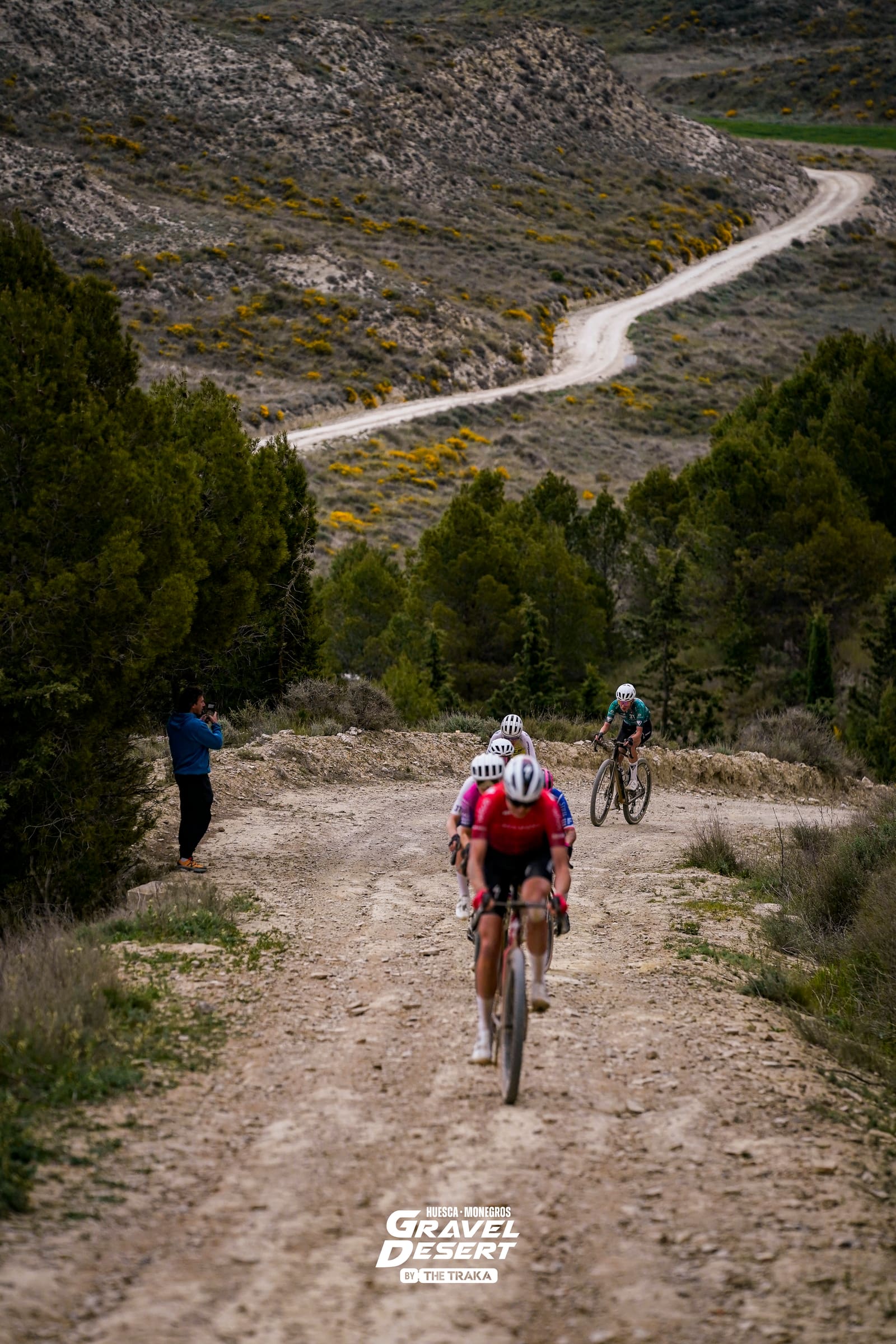
It is a semi-arid badlands landscape in the comarca of Guadix, northeast of Granada. Ravines, gullies, and canyons carved by the Gor river through clay and marl soils over thousands of years. The visual result is reminiscent of the American Southwest, but it is less than two hours from Granada city.
The territory contains more than two hundred catalogued dolmens and cave houses still inhabited in villages such as Gorafe and Villanueva de las Torres. For the gravel cyclist it means something hard to find in Europe: kilometres of unsurfaced track, radical scenery, near-total silence, and a sense of isolation that tests rider and equipment alike.
What is the terrain like for cycling?
Varied, technical, and highly sensitive to weather. In dry conditions, the dirt and sandy clay tracks roll well with a tyre of 40 mm or wider. When it rains, the ground changes character: the clay turns into sticky mud that renders the bike useless within metres. This is not an exaggeration; the Badlands organisation has cancelled entire sectors after isolated rainfall.
- Compact dirt tracks: dominant, fast rolling in dry conditions.
- Loose sand sections: require power and technique; narrow tyres sink.
- Ravine sectors: clay steps that force you to dismount at certain passages.
Elevation is not what wears you down, although short ramps above 10% appear without warning. What accumulates fatigue is the combination of kilometres, heat, technical concentration, and constant self-sufficiency.
When is the best time to go?
Spring (March to May) and autumn (September to November). Summer is impractical for long rides: temperatures regularly exceed 38 °C, shade is scarce, and the radiant heat from the clay ground amplifies the perceived temperature. In winter, rainfall turns the terrain into a trap.
Spring has an added advantage: ephemeral vegetation covers the ravines with patches of colour that transform the landscape. It is the most hospitable and most photogenic season at the same time.
What distances and routes are available?
There is no official closed circuit for recreational cyclists. The area is ridden using GPX files shared by the community or adapting sections from Badlands. As a rough guide:
- Short exploration routes: 40-70 km, ideal for a full day starting from Gorafe or Guadix.
- Long days: 80-120 km, requiring complete water and food self-sufficiency.
- Multi-day traverses linking Baza or Huéscar: over 300 km in total, requiring camping logistics or pre-booked accommodation.
If you want to assess how a Gorafe adventure fits your current preparation, a gravel cycling coach can help you gauge your base level and design the right progression.
What level of self-sufficiency do you need?
High. It is not optional.
Water is the scarcest resource. Public fountains exist in the villages, but villages are separated by distances that on gravel terrain can mean more than two hours of riding. Carrying a minimum capacity of two litres and knowing in advance where the refill points are is a requirement, not a recommendation.
Mobile coverage is irregular: there are areas where it disappears for kilometres. Riding without a dedicated GPS unit or with the GPX downloaded offline is a mistake with real consequences in this environment.
- Basic tools: patches, CO2 or pump, chain link, multi-tool.
- Sun protection: high SPF, lightweight long sleeves, glasses with good UV protection.
- Extra food: shops in small villages have limited opening hours or close on weekdays.
- Prior notice: share your route and estimated return time before you leave.
What specific kit does this terrain recommend?
Tyres from 42 mm upwards, ideally 45-50 mm if the frame allows it. The width provides floatation on sand and absorbs vibration on loose rock. Tubeless without inner tube with fresh sealant: punctures are frequent and the distance to the next assistance point can be long.
For navigation, a Garmin or Wahoo with the GPX loaded before departure. Relying solely on your phone is risky due to battery life and coverage. A small emergency power bank takes up little space and can prevent a difficult situation.
How does Gorafe connect to the Badlands race?
The Gorafe Desert is the most recognisable sector of Badlands, an unsupported bikepacking event that crosses the south of the Iberian Peninsula from coast to coast. Those who arrive here already have hundreds of kilometres in their legs, several days without a bed, and the full weight of their bivouac kit. The desert acts as the final filter.
If Badlands is on your horizon, the Badlands 2027 registration guide explains the specific steps to enter. To build the endurance and heat base the race demands, the gravel races directory lists the events that best prepare you for this type of challenge.
Are there rules to respect in the area?
Yes. Part of the territory belongs to environmentally protected zones with restricted access outside designated tracks. Leaving marked paths damages the archaeological sites and the riparian vegetation along the Gor river.
The basic rules: ride only on designated tracks, leave no waste, respect private property, and do not light fires. The environment benefits and access is preserved for the next cyclists.
If your preparation is pointing towards Gorafe or Badlands and you want to approach it properly from the start, tell us your situation at /en/apply/ and we will assess your starting point together.
Frequently asked questions
Do I need a special permit to ride a bike through the Gorafe Desert?
There is no general permit required, but part of the territory has environmental protection status that restricts access outside designated tracks. Always ride with a GPX validated by the community and respect signposted areas. Non-compliance can result in fines and damages future access for everyone.
Is it better to go alone or in a group?
A group is safer due to poor mobile coverage and the isolated terrain. If you go solo, tell someone you trust your route beforehand, carry an emergency communication device such as a Garmin inReach, and never set off with a nearly flat battery. Evacuation in the event of an accident can take hours.
What is the minimum tyre width I need to ride with control?
42 mm is the reasonable minimum in tubeless. From 45 mm upwards you gain floatation on sand and stability on technical descents. With 38 mm tyres or narrower, puncture risk increases and control on loose sand drops noticeably on the most demanding sectors.
How long does a representative route through the desert take?
A 60-80 km day with 1,200-1,500 m of elevation gain requires between 5 and 7 hours of effective pedalling under normal conditions. Always plan for more time than you calculate: technical terrain slows you down more than it appears on the map, and hydration and navigation stops are frequent.
Is the Gorafe Desert suitable for cyclists with intermediate experience?
With caveats. A cyclist with intermediate experience who handles their bike on tracks, carries appropriate kit, and avoids the summer months can enjoy the shorter routes without problems. Long traverses or the most technical sectors require a solid physical and technical base. If you are unsure about your level, consult a gravel cycling coach before heading out.
Preparing your next race?
Limited spots per edition. Training, nutrition and psychology integrated in one programme.
Apply now →